
How to Raise Resilient Children (Practical Strategies That Build Confidence, Independence, and Emotional Strength)


Why Resilience Matters More Than Ever
Every parent wants their child to be happy.
It's one of the most common hopes we have for our children.
But happiness alone isn't enough to prepare children for life.
Every child will eventually experience disappointment.
They'll lose a game they desperately wanted to win.
A friendship may end.
They may struggle in school despite working hard.
They'll hear the word "no."
They'll make mistakes.
They'll fail at something that matters to them.
These experiences are not signs that something has gone wrong.
They're part of growing up.
What determines how children respond to these inevitable challenges isn't whether they've had a perfect childhood. It's whether they've developed the ability to recover, adapt, and keep moving forward.
That ability is called resilience.
Resilience is one of the greatest gifts parents can help their children develop because it doesn't simply help children survive difficult moments.
It helps them grow because of them.
Unfortunately, resilience is also one of the most misunderstood concepts in parenting.
Some people believe resilient children are naturally fearless.
Others think resilience means children should never cry or become upset.
Some even assume children simply "toughen up" as they get older.
None of these ideas are accurate.
Resilience isn't about pretending life isn't difficult.
It's about developing the confidence and skills to face challenges, recover from
setbacks, and continue growing despite them.
Like emotional regulation, resilience isn't something children are born with.
It is something they build over time through supportive relationships, everyday experiences, and opportunities to solve problems for themselves.
The encouraging news is that parents don't need extraordinary circumstances to raise resilient children.
The ordinary moments of family life provide countless opportunities to strengthen resilience every single day.
What Resilience Really Means
The word resilience has become increasingly popular.
It's used in schools.
Sports.
Mental health.
Parenting.
Business.
Yet many people define it differently.
Before learning how to build resilience, it's important to understand what it actually means.
Resilience Is the Ability to Recover
Resilience doesn't mean avoiding hardship.
It means learning how to recover from hardship.
Think about a young tree during a windstorm.
A rigid tree may snap.
A resilient tree bends.
It moves.
It adjusts.
Then it returns upright once the storm passes.
Children develop resilience in much the same way.
They still experience disappointment.
They still feel sadness.
They still become frustrated.
The difference is that resilient children gradually learn they can move through those experiences instead of becoming stuck in them.
Resilience Is Built, Not Born
Some children appear naturally confident.
Others seem more cautious or emotionally sensitive.
Temperament certainly influences personality.
But resilience is not determined by personality alone.
Children develop resilience through repeated experiences that teach them:
"I can solve problems."
"I can recover from mistakes."
"I can ask for help when I need it."
"I can try again."
These beliefs become stronger every time children successfully work through manageable challenges.
What Resilience Is Not
Understanding what resilience isn't is just as important.
Resilience Is Not Being Fearless
Courage doesn't mean the absence of fear.
It means moving forward despite feeling afraid.
A resilient child may still feel nervous before speaking in class.
They simply learn they can handle those feelings.
Resilience Is Not Hiding Emotions
Some adults grew up believing resilience meant never crying.
Never showing weakness.
Never talking about feelings.
We now understand that healthy resilience looks very different.
Resilient children experience emotions fully.
They simply develop healthier ways of responding to those emotions.
This connects directly to → How to Teach Emotional Regulation Skills at Home (Practical Strategies That Really Work).
Emotional regulation and resilience grow together.
One supports the other.
Resilience Is Not Never Failing
Failure is one of resilience's greatest teachers.
Children who never experience failure never develop confidence in recovering from it.
Learning to fail safely is an important part of growing stronger.

Why Resilience Matters Throughout Life
Resilience doesn't only help children during childhood.
It prepares them for adulthood.
Consider some of life's biggest challenges:
Losing a job.
Ending a relationship.
Starting college.
Becoming a parent.
Moving to a new city.
Facing illness.
Beginning a new career.
Every adult eventually encounters unexpected challenges.
Resilient adults are not immune to stress.
They simply possess the confidence that they can work through difficult situations.
Those beliefs begin developing during childhood.
Resilience Supports Mental Well-Being
Children who build resilience often become better equipped to:
Manage stress.
Handle disappointment.
Solve problems.
Adapt to change.
Build healthy relationships.
Recover after setbacks.
These skills support emotional well-being throughout life.
Resilience Supports Learning
Children who fear making mistakes often avoid new challenges.
Children who develop resilience become more willing to try difficult things because they understand that mistakes are part of learning.
Instead of thinking:
"I can't do this."
They begin thinking:
"I can't do this yet."
That small word—yet—can completely change a child's mindset.
Why Children Aren't Born Resilient
Parents sometimes wonder why one disappointment completely overwhelms their child.
The answer usually isn't because something is wrong.
It's because resilience develops gradually.
Just as children learn reading, writing, and riding bicycles over time, they also learn emotional strength through experience.
The Developing Brain
Children's brains are still learning how to:
Solve problems.
Manage frustration.
Delay gratification.
Think ahead.
Control impulses.
Recover from disappointment.
When a child becomes overwhelmed by losing a game or making a mistake, they're not simply being dramatic.
They're responding with the skills they currently possess.
Over time, those skills grow.
Parents play a significant role in that growth.
Confidence Comes From Experience
Parents naturally want children to feel confident.
The challenge is that confidence cannot simply be given.
It must be earned.
Children develop confidence by doing difficult things.
Every successful experience tells the brain:
"I handled that."
"I figured it out."
"I survived."
These experiences become the foundation of resilience.
Why Struggle Is Part of Healthy Development
This idea can feel uncomfortable.
Most parents want to protect their children from pain.
That's completely natural.
However, protecting children from every struggle may unintentionally prevent them from developing resilience.
Not all struggle is harmful.
Some struggle is necessary.
Productive Struggle
Productive struggle happens when children face challenges they can overcome with support.
Examples include:
Completing a difficult puzzle.
Learning to ride a bicycle.
Solving a disagreement with a friend.
Studying for a challenging test.
Forgetting homework once and learning to prepare differently next time.
These experiences stretch children's abilities without overwhelming them.
They build confidence.
Harmful Stress
Harmful stress is different.
It overwhelms a child's ability to cope.
Children experiencing chronic fear, neglect, abuse, or ongoing instability require safety and support before resilience can grow.
Parents should never intentionally create hardship.
The goal is allowing children to experience manageable challenges while knowing trusted adults are available to support them.
Real-Life Example
Imagine your nine-year-old forgets their lunch at home.
Your first instinct may be to immediately drive it to school.
Many loving parents would.
But pause for a moment.
Ask yourself:
"Is this a safe opportunity for my child to learn?"
If the answer is yes, allowing your child to experience the natural consequence may help them become more responsible next time.
They may feel disappointed.
They may feel hungry until an alternative is arranged.
But they also learn:
"My choices have consequences."
"I can recover from small mistakes."
"I'll probably double-check my lunch tomorrow."
As discussed in → Natural Consequences vs. Logical Consequences: A Parent's Practical Guide to Teaching Responsibility, allowing children to experience appropriate natural consequences often strengthens responsibility and resilience simultaneously.
Resilience Begins With Small Everyday Moments
Many parents imagine resilience is built during life's biggest challenges.
More often, it grows during ordinary days.
A difficult homework assignment.
An argument with a sibling.
A disappointing soccer game.
A forgotten responsibility.
A friendship disagreement.
These everyday experiences become opportunities to practice problem-solving, emotional regulation, responsibility, and perseverance.
Children don't become resilient because life is easy.
They become resilient because they repeatedly discover:
"I can handle hard things."
That belief becomes stronger with every challenge they overcome.

Common Parenting Habits That Accidentally Prevent Resilience
Every parent wants to help their child.
It's one of the most natural instincts we have.
When our children are hurting, we want to comfort them.
When they struggle, we want to make things easier.
When they fail, we want to protect them from disappointment.
Those instincts come from love.
However, some well-intentioned parenting habits can unintentionally make it harder for children to develop resilience.
This doesn't mean parents should stop helping.
It simply means learning when to guide and when to step back.
Children become resilient not because adults remove every obstacle, but because they gradually learn they can overcome obstacles with support.
Finding that balance is one of the greatest challenges—and opportunities—of parenting.
Solving Every Problem for Your Child
Imagine your child is building a tower with blocks.
It keeps falling over.
They become frustrated.
As parents, it's tempting to step in and build the tower ourselves.
After all, we know how.
The problem is that when we solve every challenge, children miss the opportunity to develop the skills they need to solve future problems independently.
The Difference Between Helping and Taking Over
Helping sounds like:
"What do you think we could try next?"
"Would you like one idea?"
"Let's figure this out together."
Taking over sounds like:
"Here, let me do it."
"Move over."
"You're doing it wrong."
Although taking over often solves the immediate problem, it also sends an unintended message:
"An adult has to fix this because I can't."
Helping children think through problems builds confidence.
Solving every problem for them can slowly reduce it.
Real-Life Example
Your child is struggling with a homework assignment.
Instead of immediately giving them the answer, you might ask:
"Can you show me what you've already tried?"
"Which part makes sense, and where are you getting stuck?"
Now you're teaching problem-solving instead of simply providing solutions.
Rescuing Too Quickly
Watching children struggle can be uncomfortable.
No parent enjoys seeing disappointment, frustration, or failure.
But there is a difference between protecting children from harm and protecting them from every uncomfortable feeling.
Discomfort Is Not the Enemy
Children need opportunities to experience manageable disappointment.
Examples include:
Losing a board game.
Forgetting a homework assignment.
Not making the team they hoped for.
Receiving constructive feedback.
Working hard without immediate success.
These moments can feel difficult.
They can also become powerful learning opportunities.
Ask Yourself One Question
Before stepping in, consider asking:
"Is my child safe?"
If the answer is yes, the next question becomes:
"Can my child learn something valuable from working through this?"
Sometimes the greatest gift parents give is allowing children the opportunity to solve the problem themselves.
Fear of Failure
Many children become afraid of making mistakes.
Unfortunately, adults sometimes contribute to that fear without realizing it.
When Failure Feels Dangerous
Children may begin avoiding challenges if they believe mistakes mean:
They aren't smart.
They disappointed their parents.
They aren't good enough.
Success is the only acceptable outcome.
When children fear failure, they often stop taking healthy risks.
Instead of trying something difficult, they choose only activities where success feels guaranteed.
Over time, this limits growth.
Reframing Failure
Parents can help children view failure differently.
Instead of asking:
"Did you win?"
Try asking:
"What did you learn?"
Instead of saying:
"Don't make mistakes."
Try saying:
"Mistakes help us figure out what to practice next."
This shift encourages curiosity instead of fear.
It also connects beautifully with → Why Children Repeat the Same Mistakes (Even When They Know Better).
Mistakes are often evidence that learning is still happening.

Perfectionism Can Prevent Growth
Many parents believe encouraging children to do their best automatically builds confidence.
Sometimes it does.
Sometimes it creates perfectionism.
The Hidden Cost of Perfectionism
Perfectionistic children often:
Avoid difficult tasks.
Become discouraged quickly.
Fear criticism.
Worry about disappointing others.
Believe anything less than perfect is failure.
Ironically, perfectionism often reduces resilience.
Children become so focused on avoiding mistakes that they stop taking opportunities to grow.
Encourage Progress Instead
Parents can shift the conversation from perfection to improvement.
Celebrate questions.
Celebrate effort.
Celebrate persistence.
Celebrate trying again.
Confidence grows from progress—not perfection.
Comparing Children
Comparison is one of the quickest ways to undermine resilience.
Children naturally develop at different rates.
One child may love sports.
Another may enjoy music.
One may be highly organized.
Another may need additional support with routines.
These differences are normal.
Comparison Changes the Message
When children frequently hear comparisons, they may begin believing:
"I'll never be as good as my brother."
"She always does everything better."
"Why bother trying?"
Instead of comparing children to one another, compare children to their own growth.
Ask:
"Have they improved?"
"Are they learning?"
"Are they becoming more confident?"
That is meaningful progress.
Avoiding Every Disappointment
Many parents work incredibly hard to make childhood happy.
That's a wonderful goal.
But happiness should not come at the expense of resilience.
Children Need Safe Opportunities to Be Disappointed
Disappointment teaches valuable lessons.
Children discover:
They can recover.
Feelings change.
New opportunities appear.
One setback does not define them.
Parents who immediately remove every disappointment may unintentionally communicate:
"Difficult feelings should always be avoided."
Instead, parents can help children learn:
"Difficult feelings are uncomfortable—but manageable."
Why Confidence Comes From Competence
One of the biggest parenting myths is that confidence comes primarily from praise.
Praise is important.
But confidence grows much more deeply through competence.
Competence Creates Confidence
Think about riding a bicycle.
Children become confident because they successfully practice.
They wobble.
They fall.
They improve.
Eventually they realize:
"I can do this."
That confidence is earned.
The same principle applies throughout childhood.
Children build confidence by:
Solving problems.
Completing responsibilities.
Recovering after mistakes.
Practicing difficult skills.
Trying again after setbacks.
Parents cannot give children confidence.
Parents create opportunities for children to build it themselves.
Healthy Risk-Taking Builds Resilience
Children benefit from trying new things.
Healthy risks might include:
Joining a sports team.
Trying a new hobby.
Introducing themselves to another child.
Speaking in front of a class.
Ordering their own meal.
Spending a first night at camp.
Each successful experience expands a child's confidence.
Each challenge teaches:
"I handled something that felt difficult."
Those experiences accumulate over time.
Let Children Experience the Consequences of Their Choices
Parents often ask:
"Should I always rescue my child?"
Usually, the answer is no.
If the consequence is safe and age-appropriate, it may become one of life's best teachers.
For example:
A child forgets their library book.
Instead of rushing back to school with it, the parent allows the child to explain the situation to the teacher.
The experience feels uncomfortable.
But the child learns:
Responsibility.
Accountability.
Problem-solving.
Communication.
As discussed in → Natural Consequences vs. Logical Consequences: A Parent's Practical Guide to Teaching Responsibility, appropriate natural consequences often strengthen resilience because children discover they can recover from mistakes.
Real-Life Scenario
Your daughter tries out for the school choir.
She doesn't make it.
She comes home crying.
As parents, our first instinct may be to immediately fix the pain.
We may want to:
Call the school.
Criticize the selection process.
Tell her she should quit music altogether.
Instead, resilience-building parenting might sound like this:
"I know how disappointed you are."
"You worked really hard."
"Would you like to talk about what happened?"
"Do you think you'll try again next year?"
Notice that nothing about the disappointment changed.
What changed was the message:
"This hurts—but you can get through it."
That lesson will serve her far beyond choir auditions.
The Goal Is Not to Make Childhood Easy
Parents often feel pressure to create the perfect childhood.
In reality, children don't need perfect childhoods.
They need supportive adults who help them navigate imperfect experiences.
Every challenge becomes an opportunity to develop:
Confidence.
Perseverance.
Problem-solving.
Emotional regulation.
Responsibility.
Those are the building blocks of resilience.

Practical Ways Parents Build Resilience Every Day
If resilience is built through everyday experiences, the next question becomes:
What can parents do intentionally to help it grow?
The encouraging answer is that resilience doesn't require expensive programs, perfect parenting, or extraordinary life experiences.
It develops through ordinary moments.
The conversation after a difficult day at school.
The decision to let a child solve a problem independently.
The encouragement to try again after failing.
These seemingly small interactions gradually shape how children think about themselves and the world around them.
Children begin to develop a powerful belief:
"Life won't always be easy, but I can handle hard things."
That belief becomes the foundation of resilience.
Encourage Problem-Solving Instead of Providing Every Answer
Parents naturally want to help.
Sometimes the most helpful thing we can do is resist the urge to immediately solve the problem.
Children become resilient when they learn they are capable of finding solutions.
Become a Coach Instead of a Rescuer
Imagine your child says:
"Nobody wants to play with me at recess."
Instead of immediately offering solutions, try becoming curious.
Ask:
"Tell me what happened."
"How did that make you feel?"
"What do you think you could try tomorrow?"
"Would you like to think of a few ideas together?"
These questions communicate confidence in your child's ability to think.
Instead of solving the problem for them, you're strengthening their problem-solving skills.
Why This Matters
Every time children successfully solve a challenge—even with support—their confidence grows.
They begin to believe:
"I can figure things out."
That belief is one of the strongest predictors of resilience.
Praise Effort More Than Outcomes
Children quickly learn what adults value.
If praise focuses only on winning, perfect grades, or exceptional performance, children may begin believing their worth depends on achievement.
Resilience grows differently.
Celebrate the Process
Instead of saying:
"You're so smart."
Try saying:
"I noticed how hard you kept working even when it became difficult."
Instead of:
"You're the best player."
Try:
"I loved how you encouraged your teammates today."
Specific praise teaches children that effort, persistence, kindness, and growth matter just as much as results.
Why Effort Builds Confidence
Children cannot always control outcomes.
They cannot control:
Winning.
Being chosen.
Receiving the highest grade.
Making every team.
They can control:
Effort.
Practice.
Preparation.
Kindness.
Persistence.
Focusing on these controllable factors helps children build lasting confidence.
Normalize Mistakes
Many children begin believing mistakes are something to avoid.
Parents have an incredible opportunity to change that narrative.
Mistakes Are Teachers
Instead of asking:
"Why did you do that?"
Consider asking:
"What did you learn?"
That simple shift transforms mistakes into learning opportunities.
This connects naturally with → Why Children Repeat the Same Mistakes (Even When They Know Better).
Children learn through repetition.
Mistakes are often part of that process.
Share Your Own Mistakes
Children benefit from hearing adults say things like:
"I made a mistake at work today."
"I forgot something important."
"I handled that conversation poorly, and I'm going to apologize."
Parents who model learning from mistakes teach resilience far more effectively than parents who pretend never to make them.
Teach Healthy Self-Talk
Children develop an internal voice based largely on what they repeatedly hear.
Eventually, that voice becomes their own.
Negative Self-Talk
Many children naturally say:
"I'm terrible at this."
"I can't do it."
"Everyone is better than me."
These thoughts feel real to children.
Parents should avoid dismissing them with:
"Don't say that."
Instead, help children challenge those thoughts.
Replace Fixed Thinking
Try asking:
"Is there another way we could look at this?"
Or:
"What would you say to a friend who felt this way?"
Teach phrases such as:
"I'm still learning."
"This is hard right now."
"I can keep practicing."
"Mistakes help me improve."
"I don't know how—yet."
That final word—yet—encourages a growth mindset.
Encourage Age-Appropriate Independence
One of the greatest confidence builders is responsibility.
Children develop resilience when they realize they are capable of contributing.
Independence Looks Different at Every Age
Young children might:
Put toys away.
Help set the table.
Choose clothing.
Older children may:
Pack school bags.
Prepare lunches.
Complete homework independently.
Help with household chores.
Teenagers can gradually take on even greater responsibility.
Each new responsibility sends an important message:
"I trust you."
Trust builds confidence.
Confidence supports resilience.
Allow Children to Experience Manageable Failure
This can be one of the hardest parenting skills to practice.
Watching children struggle is uncomfortable.
Watching them fail can be heartbreaking.
Yet failure often becomes one of life's greatest teachers.
Failure Builds Future Success
Imagine a child entering a science fair.
Their project doesn't win.
The disappointment is real.
Parents cannot erase it.
But they can help children process it.
Instead of focusing on the result, ask:
What are you proud of?
What surprised you?
What would you do differently next time?
Children gradually learn that failure is an event—not an identity.
Teach Children How to Ask for Help
Resilience does not mean handling everything alone.
In fact, resilient people know when to seek support.
Children should learn that asking for help demonstrates wisdom—not weakness.
Healthy Support Systems
Encourage children to identify trusted adults they can talk to.
For example:
Parents.
Grandparents.
Teachers.
Coaches.
School counselors.
Family friends.
Knowing support is available increases confidence when challenges arise.
Model Resilience Yourself
Parents often underestimate how closely children observe them.
Children notice:
How adults handle stress.
How adults respond to mistakes.
How adults recover from disappointment.
Whether adults give up—or keep going.
Narrate Your Thinking
Children benefit from hearing statements like:
"That didn't go the way I hoped."
"I'm disappointed, but I'll try another solution."
"I'm frustrated, so I'm going to take a short break before I continue."
These simple statements teach emotional regulation and resilience simultaneously.
As discussed in → How to Teach Emotional Regulation Skills at Home (Practical Strategies That Really Work), children often borrow emotional skills from the adults around them before developing those skills independently.
Celebrate Courage, Not Just Success
Children often believe bravery means not feeling afraid.
Real courage looks different.
Courage means acting despite fear.
Celebrate moments like:
Speaking in class.
Trying a new activity.
Introducing themselves to another child.
Attempting something difficult.
Standing up for someone else.
These moments deserve recognition regardless of the outcome.
Build a Growth Mindset
Children who believe abilities can improve are more likely to persevere.
Parents can encourage this by emphasizing learning over performance.
Instead of Saying:
"You're naturally good at math."
Try:
"You've improved because you've practiced consistently."
This reinforces the connection between effort and growth.
Teach Children That Setbacks Are Temporary
One disappointing moment should never become a child's entire story.
Parents can help children separate:
The event.
From
Their identity.
For example:
Instead of:
"I'm bad at soccer."
Help children reframe:
"That game didn't go the way I hoped."
One event does not define who they are.
This perspective becomes increasingly valuable throughout life.
Real-Life Parenting Scenario
Your son practices for weeks to make the school basketball team.
The team list is posted.
His name isn't there.
He's devastated.
Rather than immediately saying:
"It's okay."
Or:
"They made a mistake."
Pause.
Sit beside him.
Acknowledge the disappointment.
"I know this hurts."
Allow space for emotion.
Then ask:
"Do you want to talk about what happened?"
Later, when emotions settle:
"What do you think you learned from this experience?"
"Would you like to try again next season?"
"What might you practice between now and then?"
The disappointment remains.
But now the child also discovers:
"I can survive disappointment."
"I can improve."
"I can try again."
Those lessons are resilience in action.
Resilience Is Built One Ordinary Day at a Time
Parents sometimes imagine resilience develops during life's biggest challenges.
More often, it develops during ordinary Tuesdays.
A difficult spelling test.
A disagreement with a friend.
A forgotten lunch.
A missed goal.
A broken toy.
Each moment becomes another opportunity to practice.
Not perfection.
Progress.
Children don't become resilient because parents remove every obstacle.
They become resilient because caring adults believe they are capable of overcoming those obstacles—with guidance, encouragement, and love.

Everyday Opportunities to Build Resilience
Parents often imagine resilience develops during life's biggest moments.
In reality, resilience is usually built during ordinary days.
Every challenge a child faces presents an opportunity to strengthen confidence, perseverance, emotional regulation, and problem-solving.
The goal isn't to create difficult situations.
The goal is recognizing the learning opportunities that naturally appear throughout everyday life.
School Challenges
School provides children with daily opportunities to build resilience.
They may:
Forget an assignment.
Receive a disappointing grade.
Feel nervous before a presentation.
Struggle with a difficult subject.
Experience conflict with classmates.
These situations can feel overwhelming in the moment, but they also teach children valuable life skills.
What Parents Can Do
Instead of immediately solving the problem, ask questions that encourage reflection.
For example:
"What do you think made this assignment difficult?"
"What might help next time?"
"Who could you ask for help if you're stuck?"
These conversations shift the focus from blame to growth.
Children begin viewing challenges as opportunities to learn rather than evidence of failure.
Friendship Challenges
Few things affect children more deeply than friendships.
Being left out of a game.
An argument with a close friend.
Feeling excluded from a group.
These experiences can be painful for both children and parents.
As adults, we naturally want to fix the situation.
Sometimes, however, our greatest gift is helping children learn how to navigate relationships themselves.
Teach Relationship Skills
Help children learn to:
Express feelings respectfully.
Listen to others.
Apologize sincerely.
Forgive when appropriate.
Solve conflicts calmly.
Recognize healthy friendships.
These skills build resilience that extends well into adulthood.
Sports and Activities
Sports, music, dance, theatre, and other extracurricular activities provide excellent opportunities to build resilience.
Children quickly learn that:
Improvement takes practice.
Success requires perseverance.
Everyone makes mistakes.
Winning isn't guaranteed.
Focus on Growth
After a game or performance, avoid asking only:
"Did you win?"
Instead ask:
What was your favorite part?
What did you learn today?
What are you proud of?
What would you like to improve?
These questions reinforce learning instead of performance.
Chores and Responsibilities
Household responsibilities do more than help parents.
They help children develop competence.
Competence builds confidence.
Confidence strengthens resilience.
Children who contribute to family life begin believing:
"I'm capable."
"People trust me."
"I can handle responsibility."
Age-appropriate responsibilities might include:
Feeding a pet.
Setting the table.
Folding laundry.
Packing lunches.
Organizing school supplies.
Helping prepare meals.
These everyday tasks quietly build independence over time.
Homework and Difficult Tasks
Homework often creates frustration.
Parents sometimes feel tempted to correct every mistake or complete difficult portions themselves.
Instead, think of homework as an opportunity to teach perseverance.
Support your child.
Encourage them.
Guide them.
But allow them to experience the satisfaction of solving problems independently whenever possible.
Remember:
The goal isn't perfect homework.
The goal is developing a learner who believes:
"I can work through difficult things."
Helping Children Recover After Failure
Failure is often where resilience grows the fastest.
Unfortunately, it's also where many parents feel the strongest urge to intervene.
Instead of immediately minimizing disappointment, create space for emotions.
A child who loses a championship game doesn't need to hear:
"It's only a game."
To them, it probably isn't.
Instead, try:
"I know this really mattered to you."
"I'm proud of how hard you worked."
"When you're ready, we'll talk about what comes next."
This teaches children that disappointment is temporary.
Growth continues.
Life moves forward.
Encourage Healthy Risk-Taking
Children cannot build confidence without trying new things.
Healthy risks might include:
Trying a new sport.
Joining a club.
Speaking in front of a class.
Ordering food at a restaurant.
Introducing themselves to another child.
Applying for a leadership role.
Every successful experience expands a child's comfort zone.
Even unsuccessful experiences build resilience because children discover they can recover.
The Importance of Letting Children Struggle
Parents often ask:
"How much should I help?"
A useful question is:
"Does my child need me to rescue them—or simply support them?"
Support might look like:
Encouragement.
Listening.
Asking questions.
Brainstorming together.
Rescuing removes the opportunity to learn.
Supporting strengthens confidence while allowing learning to happen.
Common Parenting Mistakes That Can Undermine Resilience
No parent gets this right every time.
The goal isn't perfection.
It's awareness.
Here are several common habits that may unintentionally interfere with resilience.
Expecting Immediate Success
Children learn through repetition.
Growth rarely happens overnight.
As discussed in → Why Children Need Repetition to Learn New Skills, repeated practice is a normal part of development.
Rushing to Remove Discomfort
Discomfort isn't always harmful.
Appropriate struggle often builds confidence.
Solving Problems Too Quickly
Children develop resilience by solving problems—not watching adults solve them.
Praising Only Results
Children need recognition for:
Effort.
Persistence.
Kindness.
Courage.
Improvement.
These qualities matter just as much as achievement.
Forgetting to Model Resilience
Children notice how adults respond to setbacks.
Parents who demonstrate perseverance, healthy coping, and flexibility teach resilience every day without realizing it.
What Resilience Really Looks Like
Parents sometimes expect resilient children to always appear confident.
Real resilience often looks much quieter.
It looks like:
Trying again after failing.
Asking for help.
Taking responsibility for mistakes.
Recovering more quickly after disappointment.
Attempting something despite feeling nervous.
Solving problems independently.
Continuing after setbacks.
These moments may seem small.
Together, they become the foundation for lifelong emotional strength.
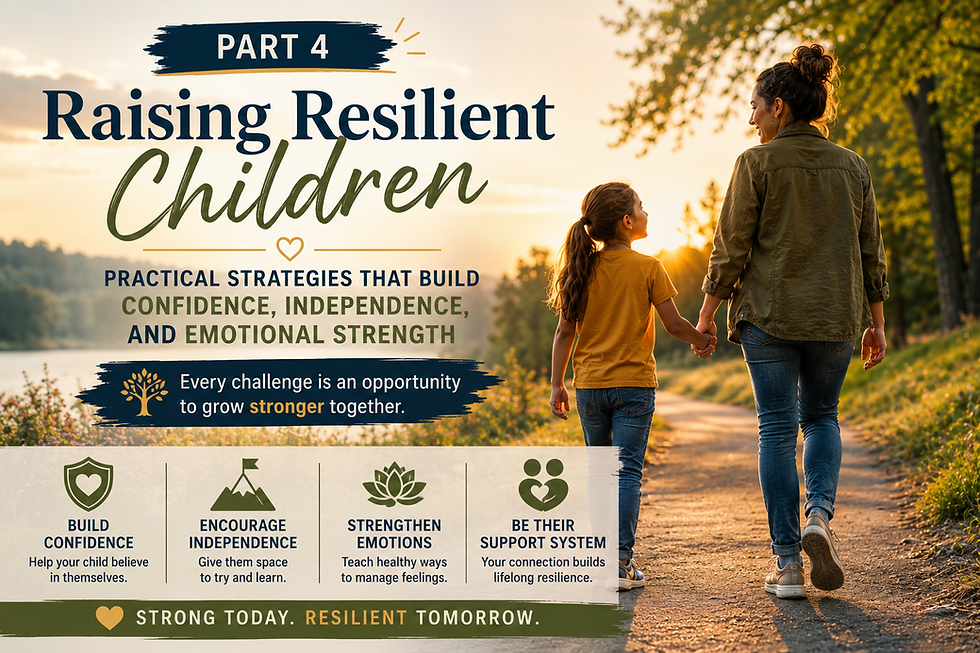
Raising Children Who Believe They Can Handle Hard Things
Resilience isn't about raising children who never struggle.
It's about raising children who trust themselves to move through life's challenges with courage, confidence, and hope.
Every disappointment becomes an opportunity to learn.
Every mistake becomes an opportunity to grow.
Every challenge becomes another reminder that difficult moments do not last forever.
Children don't become resilient because adults make life easy.
They become resilient because caring adults believe in their ability to overcome life's obstacles while providing the guidance, encouragement, and support they need along the way.
At Building Bright Futures, we believe resilience is one of the greatest gifts parents can help their children develop.
Through our Parent Coaching Services, Parenting Workshops, Family Support Programs, Parent Support Groups, and Community Education Initiatives, we provide practical, evidence-informed strategies that help families strengthen communication, build confidence, and create emotionally healthy homes.
Whether you're helping your child navigate school challenges, friendship struggles, emotional outbursts, anxiety, disappointment, or everyday parenting concerns, you don't have to figure it out alone.
Explore our Parent Coaching, Family Support Services, Parenting Workshops, and Parent Support Groups to discover how Building Bright Futures can help your family build resilience, strengthen relationships, and create a brighter future—one conversation, one challenge, and one success at a time.
Key Takeaways
Resilience is a skill that develops through experience and supportive relationships.
Children build confidence by overcoming manageable challenges.
Emotional regulation and resilience work together.
Parents should guide rather than rescue whenever it is safe to do so.
Mistakes and setbacks are valuable opportunities for growth.
Praising effort, courage, and persistence builds lasting confidence.
Healthy independence strengthens resilience.
Everyday family routines provide countless opportunities to teach resilience.
Progress is measured by recovery, perseverance, and problem-solving—not perfection.
The goal is raising children who believe they can handle life's challenges.
Frequently Asked Questions
What is resilience in children?
Resilience is a child's ability to recover from setbacks, adapt to change, solve problems, and continue moving forward after disappointment or challenges.
Can resilience be taught?
Yes. While temperament plays a role, resilience develops through supportive relationships, problem-solving opportunities, healthy boundaries, emotional coaching, and repeated life experiences.
Does protecting children from failure build confidence?
Not usually. Confidence grows through competence. Children become more confident when they successfully overcome age-appropriate challenges.
Should I let my child experience natural consequences?
When consequences are safe and appropriate, they often teach responsibility and resilience more effectively than constant rescue.
How do I know if I'm helping too much?
Ask yourself whether you're teaching your child how to solve the problem or solving it for them. The goal is to support independence, not create dependence.
What if my child gives up easily?
Encourage effort, celebrate progress, break large challenges into smaller steps, and remind your child that abilities grow through practice and perseverance.
Is it okay for children to feel disappointed?
Absolutely. Disappointment is a normal part of life. Learning to recover from disappointment is one of the building blocks of resilience.
At what age should I start teaching resilience?
From early childhood. Even toddlers begin building resilience through safe challenges, supportive relationships, consistent routines, and opportunities to try again.
How does emotional regulation affect resilience?
Children who can recognize and manage their emotions are better equipped to recover from setbacks, solve problems, and persevere through challenges.
What is the most important thing parents can do?
Believe in your child's ability to grow. Offer guidance, encouragement, and consistent support while allowing them opportunities to face and overcome manageable challenges on their own.



Comments