
AI in Education: Helpful Tool, Harmful Shortcut—or Both?

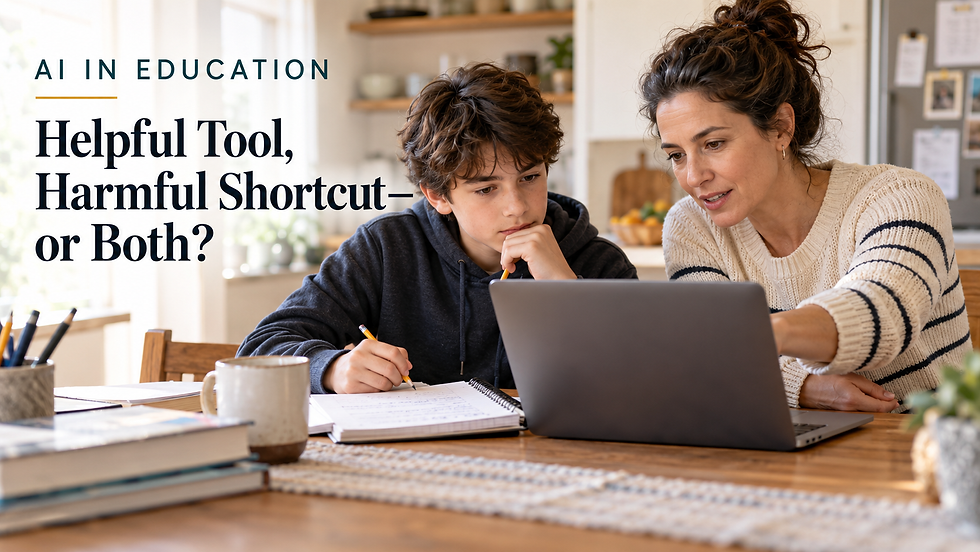
Your child closes the laptop when you walk into the room. The essay on the screen contains the phrase “multifaceted socioeconomic implications,” even though yesterday the same child described a book as “pretty good, I guess.” You do not need detective training to wonder whether artificial intelligence has joined the homework table.
Artificial intelligence is already part of education. Students use it to brainstorm, translate, summarize, quiz themselves, check grammar, generate images, solve equations, and produce finished assignments. Teachers use it to adapt lessons, create examples, draft rubrics, and reduce administrative work. Homeschooling families use it to build practice materials and explore topics that would otherwise take hours to prepare. At the same time, parents are asking serious questions about privacy, accuracy, cheating, bias, emotional dependence, worldview, and what happens when a tool completes the thinking a child needs to learn how to do.
Those concerns do not require a choice between “AI will save education” and “AI will ruin children.” Both positions are too simple. The better question is whether a particular use of AI supports a child’s thinking, safety, and development—or quietly replaces them. This guide takes a neutral, practical look at the evidence, the risks, the potential benefits, the limits of current law, and the decisions families can make right now.
This article offers general educational information, not legal advice, medical advice, or a recommendation that every child use AI. Policies, products, and laws change quickly. Parents should verify current school rules, platform terms, and legal requirements before making a decision.
Key Takeaways
AI can help a child practice, organize, and receive feedback, but better performance while using a tool is not automatically the same as lasting learning.
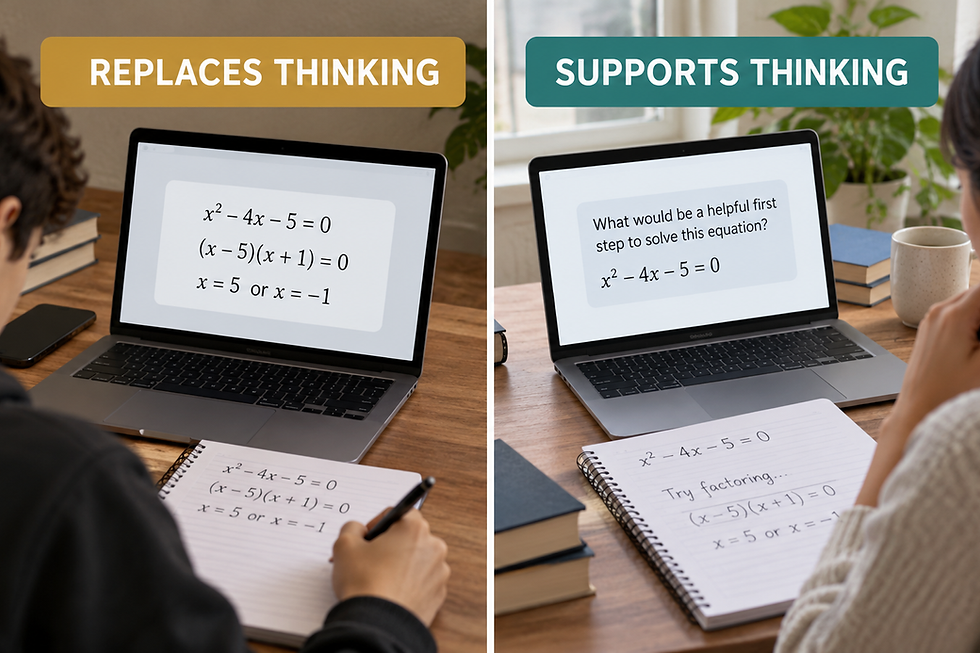
The most useful dividing line is whether AI supports thinking or replaces it. Hints, questions, examples, and feedback usually preserve more learning than a finished answer.
Children need active adult involvement. Settings help, but no parental control can verify every answer, protect every piece of data, or decide what fits a family’s values.
The evidence is still developing. Researchers have identified real opportunities and real harms, but long-term effects on children remain under-studied.
Parents should ask schools specific questions about approved tools, student data, teacher oversight, disclosure, academic integrity, bias, safety incidents, and alternatives.
Families do not have one universal legal right to reject every use of AI in school. FERPA, COPPA, Illinois privacy law, disability protections, and religious-liberty principles may apply differently depending on the facts.
A calm family plan works better than secret policing. Teach children when AI is allowed, what information never belongs in a prompt, how to verify claims, and when to ask a human for help.
If you want one sentence to guide the entire household, use this: AI may assist the learning process, but the child should still be able to explain the work, check the result, and continue when the tool is removed.
What “AI in Education” Actually Means
The term covers more than a student asking a chatbot to write an essay. Schools may use AI-powered tutoring systems, reading supports, translation tools, plagiarism detectors, lesson-planning software, adaptive practice programs, automated feedback, accessibility tools, and systems that identify patterns in student data. Some products generate new text, images, audio, or code. Others make predictions or recommend what a student should practice next.
These tools do not all carry the same risk. A speech-to-text tool that helps a student express an idea is different from a chatbot inventing the idea and writing the assignment. A teacher-controlled system that gives hints inside a bounded math lesson is different from an open chatbot that can discuss almost anything. A platform that stores a child’s conversations and uses them to improve a commercial model creates different privacy questions from software operating under a tightly written school contract.
That is why broad questions such as “Is AI good for children?” produce broad, unsatisfying answers. Parents need to know which tool is being used, for what purpose, with what information, under whose supervision, and what the child is expected to do independently before and after using it.
The child’s age and needs also matter. An older teen practicing interview questions may be able to evaluate a weak answer that a younger child would accept as fact. A student with dyslexia may use text-to-speech or structured writing support to access a lesson without outsourcing the underlying ideas. A child who is lonely or distressed may relate to a conversational system in ways that deserve more caution than a five-minute vocabulary exercise.
What the Research Can—and Cannot—Tell Parents Yet
AI products are changing faster than long-term child-development research can follow them. By the time a multi-year study is completed, the model, interface, safeguards, and school practices may be different. That does not mean parents should ignore evidence. It means they should resist confident claims that a new tool has been proven either harmless or transformative for every child.
The UNICEF Guidance on AI and Children emphasizes that medium- and long-term effects on children’s development, learning, and psychological well-being remain under-researched. UNICEF also identifies documented risks involving privacy, bias, misinformation, cyberbullying, sexualized deepfakes, child sexual abuse material, and systems that may encourage emotional dependence. Those are not reasons to panic; they are reasons to demand child-centered design and meaningful adult oversight.
A 2024 field experiment involving nearly one thousand high-school mathematics students illustrates an important distinction. Students with access to a general-purpose AI assistant performed better while they could use it, yet some performed worse later when the assistance was removed. A more carefully designed AI tutor that guarded the learning process reduced that penalty. The study does not settle every question about AI tutoring, but it supports a practical warning: a tool can improve today’s worksheet without improving tomorrow’s understanding. Parents can read the working paper on generative AI and student learning for the methods and limitations.
The American Psychological Association report on educational technology and learning makes a related point: technology may raise task performance without producing durable learning. Children learn when they retrieve information, make mistakes, revise ideas, explain reasoning, and gradually do more independently. If AI removes those productive difficulties, the child may look successful while becoming more dependent.
The evidence therefore supports neither blanket adoption nor blanket rejection. It supports careful design, age-appropriate limits, transparency, and frequent checks that the child is doing the cognitive work the assignment was meant to develop.
The Most Important Test: Does AI Support Thinking or Replace It?
Imagine a child facing a difficult fraction problem. In one version, the child pastes the problem into a chatbot, copies the answer, and closes the window. In another, the child attempts the problem, asks for one hint, explains the next step, and uses the tool to check the reasoning. Both children used AI. Only one protected the learning process.
Supportive use keeps the child intellectually present. The tool may clarify directions, define a term, generate another practice problem, ask a guiding question, model one example, or give feedback on work the child already produced. Replacement use delivers the central thinking: the thesis, solution, interpretation, code, or personal reflection the student was expected to create.
A simple parent test is to remove the screen and ask, “Tell me what you did and why.” A child does not need a perfect explanation. Hesitation is normal. But if the child cannot describe the main idea, reproduce a similar step, identify a source, or explain which parts came from AI, the tool probably carried too much of the load.
This distinction is more useful than judging every product as good or bad. The same chatbot can be used as a patient practice partner or an invisible ghostwriter. The same school platform can provide accessible scaffolding or reduce a rich assignment to clicking until the green checkmark appears. Purpose, prompt, supervision, and follow-up determine much of the educational value.
Where AI Can Genuinely Help
Used with limits, AI can lower barriers that prevent a child from beginning. It can turn a confusing direction into plain language, create examples at a child’s reading level, provide extra practice without requiring a parent to invent twenty new questions, and offer immediate feedback when a teacher is not available. For some learners, those supports make the difference between avoiding the work and entering it.
AI can also support accessibility. Text-to-speech, speech-to-text, translation, visual descriptions, organizational prompts, and adjustable explanations may help students participate more fully. The goal should be access rather than erasure of the learner’s voice. A child who dictates an original idea is still thinking. A system that invents the idea and merely asks the child to approve it is doing something different.
For older students, AI can become a useful opponent rather than an answer machine. A student can ask it to challenge an argument, pose questions from a different point of view, conduct a mock interview, identify missing evidence, or generate a counterexample. The student then evaluates the response. This makes verification and judgment part of the assignment.
Teachers and parents may also save preparation time. AI can draft a reading passage about a child’s favorite topic, produce several versions of a practice quiz, suggest a hands-on demonstration, or convert a long lesson into a short review plan. Adults still need to check accuracy, age appropriateness, bias, and fit. A fast draft is valuable only when a responsible person remains the editor.
The Risks Parents Should Take Seriously
Confidently Wrong Answers
Generative AI predicts plausible language; it does not guarantee truth. It may invent books, quotations, court cases, historical details, scientific explanations, or web addresses. The answer can sound polished enough that a child—and sometimes an adult—does not notice. “It sounded certain” is not evidence. Children need a routine of checking important claims against class materials, original sources, or trustworthy reference sites.
Learning Without the Learning
The easiest shortcut is not always obvious plagiarism. A child may repeatedly ask AI to simplify, outline, rewrite, and improve until almost none of the original struggle remains. The final work may be technically new yet educationally empty. Productive struggle should not become needless frustration, but removing every moment of retrieval, planning, and revision can weaken the very skills school is trying to build.
Privacy and Student Data
A prompt can reveal a child’s name, school, schedule, location, disability, diagnosis, family conflict, political or religious beliefs, photographs, voice, or unfinished personal writing. That information may be stored, reviewed, or processed in ways a family did not expect. Children should never paste private records, identifying details, passwords, intimate images, or information about another person into an AI system. Parents should read the privacy notice and ask schools what data the vendor receives, how long it is retained, whether it trains models, and how deletion works.
Bias and Worldview
AI systems learn patterns from data and are shaped by developer choices, policies, and safety rules. Their answers can reflect cultural assumptions, stereotypes, political framing, or incomplete representation. No major system is viewpoint-free. Families across the political and religious spectrum may encounter answers that conflict with their beliefs. The appropriate response is not to pretend neutrality exists; it is to teach children that an AI answer is one constructed output, not a moral authority.
Cheating, Authorship and Trust
School rules vary. A teacher may allow brainstorming but prohibit generated sentences, or permit grammar feedback only when the student discloses it. A child can violate a policy without understanding where the line is. Schools should explain allowed and prohibited uses for each assignment, and students should be able to state how they used the tool. Secret use damages trust even when the generated content is not copied word for word.
Manipulation, Deepfakes and Sexual Harm
AI can be used to create humiliating fake images, impersonate peers, automate harassment, or produce sexualized material involving children. A young person may also be pressured to upload a photo “as a joke.” Families should state plainly that creating, requesting, sharing, or threatening someone with intimate or degrading synthetic media is harmful and may carry school discipline or legal consequences. If a child is targeted, preserve evidence, stop further sharing, report the content to the platform and school, and seek law-enforcement or legal guidance when appropriate.
Emotional Dependence and Human Displacement
A conversational system can feel unusually patient and available. That may be comforting, but it can also invite a child to treat software as a confidential friend, counselor, or authority. AI should not replace relationships with parents, teachers, peers, physicians, or mental-health professionals. A child in danger, experiencing abuse, or expressing thoughts of self-harm needs prompt human help—not a longer conversation with a chatbot.
A Five-Step Family Rule: Brain First, AI Second
Families do not need a forty-page technology constitution. A repeatable sequence is easier to remember and easier to enforce. Try this five-step approach whenever AI is used for schoolwork.
Try first. The child reads the directions and makes a genuine attempt before opening the tool, unless an accessibility need requires support at the start.
Ask for help, not completion. Request a hint, question, example, definition, or explanation. Avoid “do this for me.”
Verify. Check factual claims, calculations, quotations, and sources against reliable material.
Explain it back. The child closes or minimizes the AI and explains the answer in their own words or completes a similar problem independently.
Disclose. Follow the teacher’s rule and state what tool was used and how. Save prompts when the assignment requires a record.
This sequence is not punishment. It turns AI use into a visible learning process. It also gives parents a way to discuss a questionable assignment without beginning with an accusation. “Show me what you tried before you asked” is more useful than “Did a robot write this?”
Parental Controls Help, but They Are Not a Substitute for Parenting
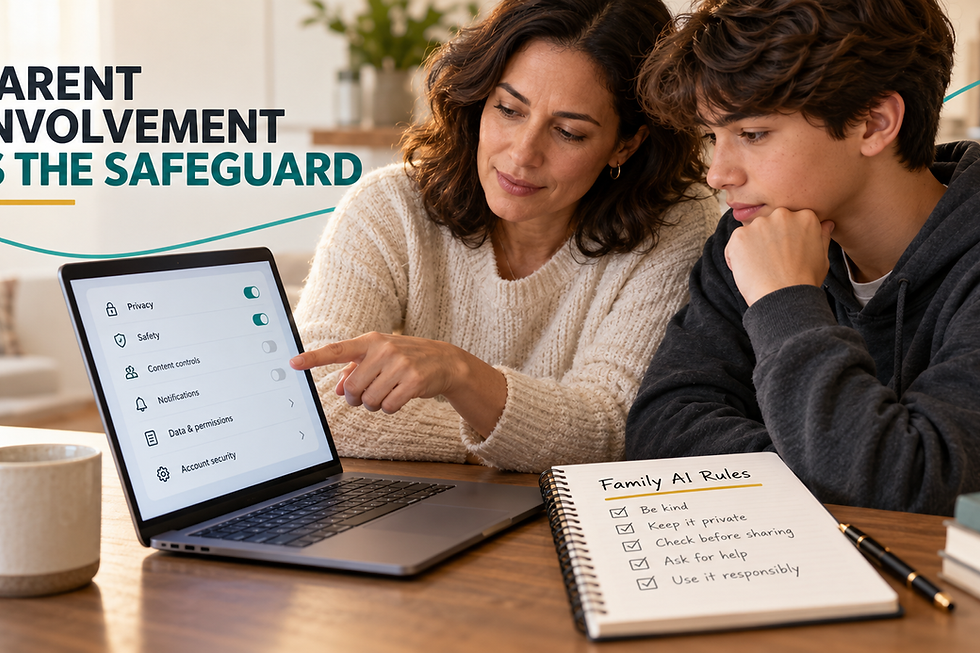
Some platforms now provide family settings. OpenAI’s current ChatGPT parental controls allow a parent and teen account to be linked. Depending on the available settings, a parent may manage sensitive-content protections, model-training permissions, memory, voice, image generation, quiet hours, and other features. OpenAI states that parents do not receive access to a teen’s conversation history, and teens can unlink the account, with notice to the parent. Families should review the current documentation because features and availability can change.
These controls can reduce exposure and create useful boundaries, but they cannot make every response accurate, prevent a child from using another service, or decide whether a prompt is appropriate for a particular assignment. Technical settings work best alongside conversation, shared expectations, and occasional use in the same room.
For younger children, parents should be especially cautious about general-purpose chatbots. Many services set minimum ages or require parental permission, and age gates can be easy to bypass. UNESCO has recommended that countries consider a minimum age of thirteen for independent classroom use of generative AI. That is policy guidance, not a universal law, but it reinforces the value of adult-led use for younger students.
A practical setup session should include more than clicking safety toggles. Sit together and test the tool. Ask it one factual question and verify the answer. Ask it to help with a sample problem without giving the solution. Look at the history and data settings. Decide which topics require a human. Let the child see that responsible use includes skepticism.
A Family AI Agreement That Can Fit on One Page
Write the rules with your child rather than delivering them as a surprise after something goes wrong. The agreement can be simple: where AI may be used, what uses require permission, what information stays private, how school rules will be followed, and what happens when the tool produces troubling content.
We use AI for learning support, not secret completion.
We do not enter private, identifying, medical, financial, sexual, or confidential information.
We verify important facts and never invent citations.
We follow each teacher’s rules and disclose AI help honestly.
We do not create fake, sexualized, humiliating, or deceptive content about another person.
We bring confusing, upsetting, or manipulative responses to a trusted adult.
Parents will respond to mistakes with safety and teaching first, while still using reasonable consequences.
Revisit the agreement when the child changes schools, receives a new device, begins using a new platform, or demonstrates more responsibility. A twelve-year-old and a seventeen-year-old should not have identical boundaries. Increasing freedom should follow demonstrated judgment, not merely a birthday.

How Homeschooling Families Can Use AI Without Handing Over the Teaching
Homeschooling parents often perform several roles at once: teacher, scheduler, curriculum researcher, transportation department, lunch staff, and the person trying to remember where the good pencils went. AI can reduce preparation work, especially when a family needs multiple reading levels, fresh practice, or a different explanation.
A parent can use AI to draft a week of review questions, turn a science topic into a scavenger hunt, create a vocabulary game, suggest books to verify at the library, produce sample sentences, or adapt a lesson for a child who needs shorter steps. It can generate a first version of a rubric or help a parent think of ways to connect mathematics with cooking, sports, building, or budgeting.
The parent should remain the curriculum decision-maker. Check generated materials before the child sees them. Confirm facts and sources. Remove stereotypes, ideological assumptions, or content that does not fit the child’s maturity or the family’s goals. Make sure the lesson includes real reading, writing, discussion, movement, experiments, books, and people—not simply more time conversing with a screen.
AI is particularly useful for variation. If a child understands multiplication but needs fluency, a parent can create ten new problems at an appropriate level and ask for an answer key separately. If a child is stuck on a concept, the parent can request three explanations using different examples, then select the clearest one. The parent is curating; the AI is drafting.
Prompts Parents Can Use for Tutoring Materials
“Create eight fraction problems for a fifth-grade student. Begin with two straightforward examples, then increase difficulty gradually. Do not provide answers until a separate answer-key section. Check every answer before presenting it.”
“Explain photosynthesis in three ways: a plain-language explanation, an analogy, and a short hands-on demonstration using common household materials. Flag any safety concerns and list facts I should verify.”
“Act as a tutor. Ask my child one question at a time about this paragraph. If the answer is incorrect, give a hint rather than the answer. After five questions, summarize which idea needs more practice.”
“Create a discussion guide that presents the strongest arguments on more than one side of this issue. Separate verifiable facts from opinions and identify primary sources a parent can check.”
Parents should avoid pasting copyrighted curriculum pages, student records, diagnostic reports, or another child’s work into a general-purpose system unless they have confirmed that the use is permitted and private. Describe the learning goal without supplying identifying material whenever possible.
AI Learning Platforms Families May Want to Evaluate
No platform deserves automatic trust because it uses the words “for education,” and ratings can change. The following examples are a starting shortlist, not endorsements. Review current age requirements, cost, privacy terms, school contracts, accessibility, and independent evaluations before choosing.
Khanmigo
Khanmigo from Khan Academy is designed to guide learners through questions rather than simply hand over answers. Khan Academy states that students under eighteen receive access through a parent or a participating school. Its connection to Khan Academy content can make the learning context clearer than an unrestricted chatbot, but adults should still review usage, privacy, and whether the child can perform independently.
ChatGPT for Teens
ChatGPT for Teens provides age-related protections and can be linked with parental controls. It is a broad tool rather than a school curriculum. That flexibility supports brainstorming, explanation, practice, and creation, but it also means families must define boundaries and verify outputs carefully.
MagicStudent
MagicStudent is built for educator-directed student use and provides tools within a school-oriented environment. The company states that its products are designed for compliance with student-privacy requirements, including FERPA and COPPA. Treat those as vendor claims to be examined through the school’s contract and privacy review rather than a guarantee that every implementation fits every family.
SchoolAI
SchoolAI offers teacher-created or teacher-monitored spaces and advertises classroom safety and visibility features. Its usefulness depends heavily on how the school configures it, what conversations teachers can see, what alerts are generated, and what student data is retained. Parents should ask for the district’s approved-use explanation rather than relying only on the marketing page.
When comparing products, favor tools that make the instructional goal visible, limit unnecessary data collection, allow adult oversight, explain how outputs are generated, provide reporting and deletion processes, and make it easier to ask for hints than to obtain finished work. A glowing review about convenience does not answer those questions.
Questions Parents Should Ask Teachers and School Districts
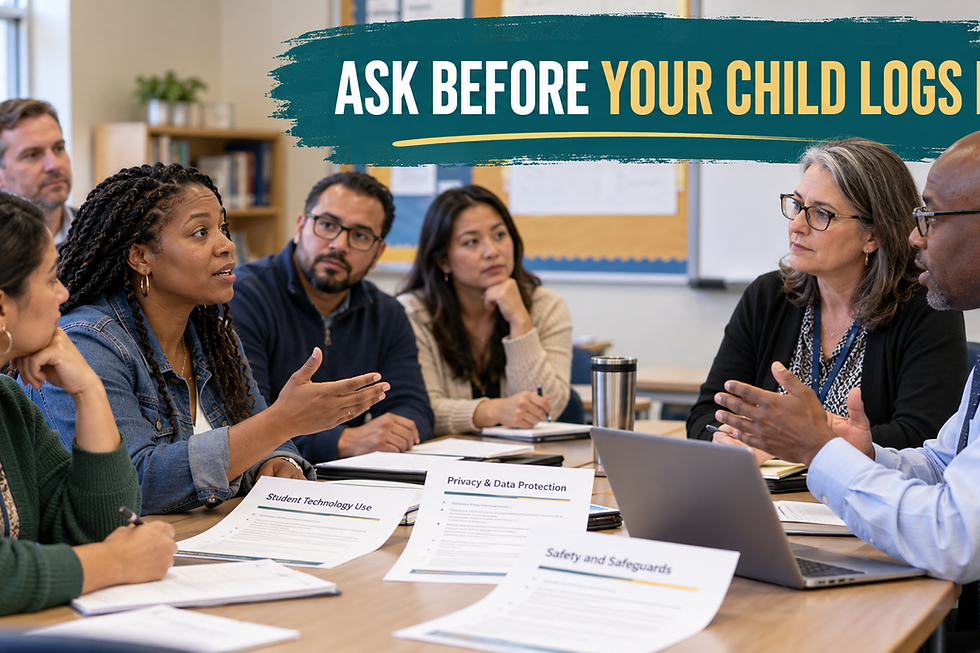
“We use AI responsibly” is not a policy. Parents deserve enough detail to understand what happens to their child’s work and how the school protects learning. Begin with the classroom teacher when the question concerns a particular assignment; contact school or district administration when it concerns contracts, privacy, curriculum, or system-wide rules.
Which AI tools are approved, and which are prohibited? Ask for names, purposes, grade levels, and whether use is required or optional.
What learning goal requires this tool? The school should be able to explain why AI improves access or instruction rather than merely appearing modern.
What data is collected? Ask about prompts, documents, voice, images, identifiers, device data, conversation history, teacher comments, and derived profiles.
Who can see the data, and how long is it kept? Include the vendor, subcontractors, teachers, administrators, and law enforcement requests.
Is student data used to train or improve models? If not, ask where that promise appears in the contract.
How are parents notified of changes or breaches? Ask for the district contact responsible for student privacy.
How do teachers verify learning? Students should still complete meaningful work without AI and explain their reasoning.
How are hallucinations, bias, and unsafe content handled? Ask what staff training and incident-reporting process exists.
What is the academic-integrity rule? Students need assignment-specific examples of permitted help, prohibited help, and required disclosure.
What alternative is available? Ask how a student can meet the same educational goal without the platform when a privacy, disability, or religious concern is raised.
Request the answer in writing when the issue matters to your family. A written request creates clarity and gives the school an opportunity to involve the right administrator. Keep the tone specific and practical: identify the tool, assignment, concern, and alternative you are requesting.
When a Family Has Religious or Worldview Concerns
Some parents worry that an AI system will present contested questions about sex, gender, family, religion, politics, or morality as though only one acceptable view exists. Other parents worry about discrimination, stereotyping, or the exclusion of their own family’s identity. These concerns can be discussed without insulting children, families, teachers, or people who hold different beliefs.
Teach children to separate factual claims, interpretation, and moral judgment. An AI answer can be compared with course materials, primary sources, family beliefs, and perspectives from more than one responsible human source. A child can learn to say, “This system is giving me one framing. What assumptions are behind it? What would a thoughtful person who disagrees say?” That is a durable critical-thinking skill.
If a school-required use creates a sincere religious concern, describe the specific lesson, prompt, output, or participation requirement. Ask what educational objective the school is pursuing and propose an alternative that meets the same objective. Broad statements that all AI is objectionable may be harder for a school to evaluate than a concrete request tied to a particular burden.
In 2025, the U.S. Supreme Court held in Mahmoud v. Taylor that parents challenging a school district’s mandatory use of certain LGBTQ-inclusive storybooks without opt-outs were entitled to a preliminary injunction on the facts before the Court. That decision is important, but it does not create an automatic parental veto over every curriculum choice or technology. The legal analysis depends on the specific policy, burden, jurisdiction, and requested accommodation. Families facing a serious dispute should seek advice from a qualified attorney rather than relying on a blog summary.
What Rights Do Families Have If They Do Not Want School AI Use?
There is no single federal law that gives every parent a blanket right to opt a child out of every AI tool, lesson, or automated process. Rights may come from several sources, and they apply differently depending on what the school collects, the child’s age, whether the school is public or private, the purpose of the tool, and whether a disability or sincere religious burden is involved.
FERPA
The federal Family Educational Rights and Privacy Act gives eligible parents rights concerning access to, amendment of, and disclosure of education records. Schools may disclose certain information to contractors under conditions that treat the contractor as a school official. FERPA can support questions about records and vendors, but it is not a universal AI opt-out law.
COPPA
The Federal Trade Commission’s Children’s Online Privacy Protection Rule governs certain online services collecting personal information from children under thirteen. In the educational context, a school may sometimes provide consent on a parent’s behalf when the service is used for the benefit of the school and not for an unrelated commercial purpose. COPPA provides important protections, but it likewise does not guarantee that every parent can refuse every school-approved service.
Illinois Student Privacy Requirements
Illinois schools and vendors also operate under state student-privacy requirements, including the Student Online Personal Protection Act. Districts generally must maintain information about covered operators and contracts and must respond to breaches and parent requests as the law requires. The Illinois State Board of Education AI guidance encourages districts to address privacy, security, equity, transparency, academic integrity, and human oversight. Guidance is useful, but parents should still ask for their own district’s adopted policy and vendor information.
Disability and Access
A student’s individualized education program, Section 504 plan, or other disability protections may affect how technology is used or what alternative access is required. AI can sometimes be an accommodation; in other cases, a particular system may create an accessibility barrier. Raise the concern with the child’s educational team and focus on equal access to the learning goal.
A Practical Request Process
Identify the exact use. Name the platform, assignment, data collection, or required interaction.
Request the policy and privacy documents. Ask for the approved-app list, contract information, parent notice, and alternative procedure.
State the concern clearly. Explain whether it involves privacy, accuracy, disability, academic integrity, safety, or sincere religious belief.
Propose a workable alternative. For example, a printed resource, human-led tutoring, a different approved program, or completion of the same objective without an account.
Ask for a written response and appeal path. Keep copies of communications and note deadlines.
Seek qualified help when necessary. For a significant legal dispute, contact an attorney or appropriate advocacy organization familiar with education and privacy law in your jurisdiction.
A cooperative first approach often resolves more than a public confrontation. The aim is not to make teachers defend the existence of modern technology. It is to obtain enough information to protect the child and preserve the educational goal.
How to Know When AI Is Replacing Learning
The warning signs are usually patterns, not one polished sentence. A child may finish assignments unusually quickly but cannot discuss them; vocabulary and writing style change abruptly; cited sources do not exist; mistakes repeat because the child copies without checking; anxiety rises whenever the tool is unavailable; or the child increasingly asks AI to make ordinary decisions that once involved personal judgment.
Do not begin by trying to win a confession. Ask the child to walk through the process, show the prompt history when appropriate, explain one key idea, and complete a similar task with support but without AI. The goal is to find the missing skill. The child may be avoiding work, but the behavior may also reveal confusion, perfectionism, fear of failure, reading difficulty, executive-function challenges, or an assignment that feels impossible.
A useful response combines accountability with repair. The child may need to redo the work, inform the teacher, lose unsupervised access temporarily, or practice the skill directly. At the same time, the adult can help divide the task into smaller steps and define an allowed way to use AI next time. Shame teaches secrecy; a clear repair plan teaches responsibility.
If conflict around schoolwork is becoming constant, BBF’s parent coaching can help families build practical routines, communication strategies, and boundaries. Coaching is non-clinical and does not replace school evaluation, psychotherapy, legal advice, or specialized treatment.
A Realistic Home Routine for AI-Assisted Homework
Choose one visible place for AI-assisted schoolwork when possible. Begin with the teacher’s rule and the child’s own attempt. Set a short purpose before opening the tool: “We are asking for a hint on step two,” not “We are finishing math.” Keep source material nearby so claims can be checked. End with an independent explanation or a similar problem.
For writing, preserve evidence of authorship. The child can save an outline, notes, early draft, AI prompts, and final revision. Parents can ask which sentence the child is proud of and what changed after feedback. If the child cannot identify their own choices, the process may have drifted from assistance to substitution.
For research, require source-first work. Instead of asking the chatbot to supply facts and citations, have the child locate trustworthy sources, read them, and then use AI to generate questions or challenge a conclusion. This reverses the common pattern in which a fabricated citation is discovered ten minutes before bedtime, shortly after everyone’s patience has left the building.
For tutoring, stop before fatigue turns the tool into an answer dispenser. A twenty-minute session with three well-explained problems can teach more than an hour of rapid completion. End by naming what the child can now do and what still needs human help.
What Parents Can Ask an AI Tutor to Do Instead of Giving Answers
Prompt design matters because the default request often rewards speed. Parents can set the role and limits before the child begins. Useful instructions include: ask one question at a time; do not provide the final answer; wait for the student’s attempt; point out the first incorrect step; offer two hints before showing an example; ask the student to explain the rule; and finish with one new problem to solve independently.
For reading, ask the tool to question the child about evidence in the text rather than summarize the chapter. For writing, ask it to identify where a reader may be confused without rewriting the paragraph. For history, ask it to distinguish primary and secondary sources and flag claims that need verification. For science, ask it to challenge the student’s hypothesis and request evidence.
Parents can also ask the system to admit uncertainty: “If you are not confident, say so. Do not invent sources. Label any claim I should verify.” This will not eliminate errors, but it establishes the correct expectation. Verification remains a human job.
How Schools Can Use AI More Responsibly
Responsible school use begins with a defined educational problem. A district should not collect student data merely because a vendor offers a free pilot or because neighboring districts have adopted a tool. Leaders should identify the instructional need, evaluate less intrusive alternatives, conduct privacy and security review, test accessibility, involve teachers and families, and establish a process for complaints and incidents.
Teachers need more than a list of prohibited websites. They need time and training to design assignments that make thinking visible, teach source verification, discuss appropriate disclosure, and respond consistently when misuse occurs. Students need clear examples. “You may use AI to generate practice questions, but not to produce any sentence submitted for credit” is easier to follow than “Use responsibly.”
Schools should also preserve meaningful non-AI pathways. A child should not lose access to education because a family raises a legitimate privacy concern, lacks reliable internet, uses assistive technology differently, or requests a legally required accommodation. Alternatives should meet the same learning objective without becoming punitive busywork.
Finally, districts should publish enough information for accountability: approved tools, purposes, data categories, vendor agreements where required, retention rules, breach procedures, staff contacts, academic-integrity expectations, and the process for requesting an alternative or correction. Transparency is not anti-technology. It is part of trustworthy technology use.
When to Bring in a Human
Some questions belong with people even when AI can produce an answer. A teacher should clarify assignment rules and evaluate academic progress. A school specialist should address possible learning needs. A physician or therapist should evaluate health and mental-health concerns. An attorney should interpret legal rights in a real dispute. A faith leader chosen by the family may help with religious questions. Trusted adults provide context, accountability, relationship, and professional responsibility that a conversational system does not possess.
Bring in a human promptly when a child reports abuse, exploitation, threats, sexual content, blackmail, self-harm, severe anxiety, hallucinations, or danger to anyone. Do not ask the child to keep experimenting with the chatbot so you can gather a better answer. Preserve necessary evidence without redistributing harmful images, secure the account, and contact the appropriate professional or authority.
For ordinary family strain—arguments, homework battles, inconsistent boundaries, or uncertainty about how much independence to allow—Building Bright Futures offers practical, non-clinical support. Our parenting workshops provide education and strategies; parent support groups provide connection with other caregivers; and the Request Support form offers a starting point when you are unsure what kind of help fits. BBF does not evaluate AI products for schools, provide therapy, diagnose children, or give legal advice.
Frequently Asked Questions
Is AI harmful to children?
AI is not one exposure with one effect. Harm depends on the tool, content, age, data practices, supervision, purpose, and what the use replaces. Documented concerns include misinformation, privacy loss, bias, academic dependence, deepfakes, harassment, and emotional overreliance. Potential benefits include accessibility, practice, feedback, translation, and reduced preparation time. Long-term developmental evidence remains limited, so cautious, supervised use is reasonable.
What age should a child begin using generative AI?
There is no universal age that makes every use safe. Follow platform requirements, school policy, and the child’s maturity. UNESCO has suggested thirteen as a minimum for independent classroom use, while younger children may encounter adult-led educational applications. The key word is independent: a parent or teacher should be more involved when a child is younger, more trusting, or less able to verify claims.
Is using AI for homework cheating?
It depends on the teacher’s instructions and what the tool does. Generating a practice quiz may be allowed; generating the submitted response may not be. When a rule is unclear, the student should ask before using AI and disclose the use afterward. If the student would hide the prompt from the teacher, that is a strong signal to stop and clarify.
Can parental controls let me read my teen’s ChatGPT conversations?
OpenAI’s current parental controls do not give parents routine access to a teen’s chat history. They allow management of certain features and protections after accounts are linked. Review current official documentation because settings can change. Families should discuss what privacy a teen can expect and what safety circumstances require adult involvement.
Can I opt my child out of AI at a public school?
Sometimes an alternative may be available or legally required, but there is no blanket federal opt-out covering every AI use. Ask the school for the exact tool, purpose, policy, privacy documents, and alternative process. A disability, privacy issue, or sincere religious burden may change the analysis. Seek qualified legal advice for a significant dispute.
How can homeschoolers use AI well?
Use it as a planning and practice assistant. Let it draft questions, examples, games, schedules, and alternative explanations, then have the parent review everything. Keep books, discussion, writing, projects, outdoor learning, community activities, and real relationships at the center. The parent remains responsible for educational decisions and legal homeschool requirements.
Which AI app is safest for children?
No product can be declared safest for every child and use. Begin with the narrowest tool that meets the educational goal. Prefer clear age rules, minimal data collection, strong adult controls, transparent school contracts, learning-oriented guardrails, reporting processes, and independent privacy or educational review. Recheck the product over time.
What if my child already used AI to complete an assignment?
Stay calm, learn exactly what happened, and review the teacher’s rule. Have the child explain the work and redo the parts they did not understand. When required, help the child disclose the use and repair the situation. Add supervision and a clearer process for the next assignment. Accountability matters, but humiliation is unlikely to build honesty.
The Goal Is Not to Raise a Child Who Never Uses AI
Most children will live and work around artificial intelligence. Avoiding every tool may be unrealistic, while accepting every tool would be unwise. The stronger goal is to raise a young person who can use powerful technology without surrendering curiosity, judgment, honesty, privacy, or human connection.
That child knows how to attempt a problem, ask for the right kind of help, verify a claim, explain an answer, disclose assistance, and walk away from a system that crosses a boundary. They understand that convenience is not the same as learning and that polished language is not the same as truth.
Parents do not need to become computer scientists to teach those habits. They need accurate information, a few firm rules, ongoing conversation, and the willingness to ask schools and companies specific questions. The technology will keep changing. Those parenting skills will remain useful.
If digital tools are creating conflict, confusion, or pressure in your home, Building Bright Futures can help you build practical boundaries and communication routines. Use the Request Support form linked above, and we will help you identify an appropriate non-clinical next step.


Comments